
• Home
  • Categories
    • Privacy Policy
      • Cookie Policy
    • Links
  • About NP
    • Welcome to Neurosomatic Psychology.com
    • What Is Trauma?
    • What is Neurosomatic Psychology?
      • Where Can I Attend NP Programs
      • Sponsor Neurosomatic Psychology
    • About Richard
  • NEED HELP NOW?
  • FAQ
  • Blog
  • Contact
info@neurosomaticpsychology.com
Neurosomatic PsychologyNeurosomatic Psychology
  • Home
  • Categories
    • Privacy Policy
      • Cookie Policy
    • Links
  • About NP
    • Welcome to Neurosomatic Psychology.com
    • What Is Trauma?
    • What is Neurosomatic Psychology?
      • Where Can I Attend NP Programs
      • Sponsor Neurosomatic Psychology
    • About Richard
  • NEED HELP NOW?
  • FAQ
  • Blog
  • Contact

NEUROSOMATIC TRAUMA RELEASE

Home NEUROSOMATIC TRAUMA RELEASE

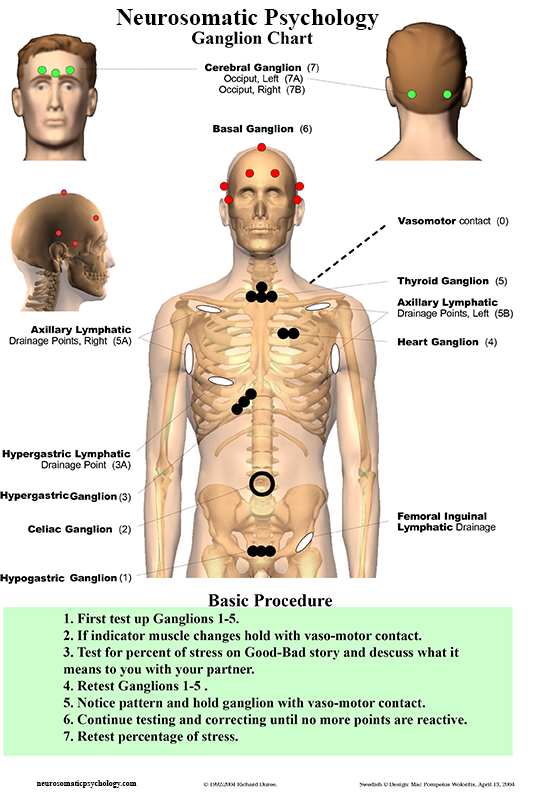
This technique is designed to be used by two people. One person, the client, lying down and the other person holding the points sequentially. If you are not familiar with muscle testing simply have the person (client) lie on their back and begin to breath. Have them bring up the issue they wish to work on.

(If the issue is a highly traumatic one, please do a few sessions on simply relieving the stress in the body before bringing up the traumatic issue.)

Begin having them talk about the issue using the Feel, Want, and Willing script below.

Begin at number one on the chart by putting a firm pressure on the first points. Make a second contact with the other hand on a large muscle and make a slight tug and hold it. When you notice a change in the character of the tissue at the ganglion site, or you notice the person taking a deep breath move to the next ganglion point. Make sure that the person is breathing deeply and regularly.

Feel
Want Willing

The central theme of this exercise is a communications methodology called
“feel-want-willing”. Basically, it encourages you to express your
needs in three steps:

– feel – describe the problem you
face in terms of how it makes you feel

– want – state what you want for
resolving the problem

– willing – state what you are willing to do in order to achieve what you want

Feel: The first stage isn’t empty. It tells the other person how the problem is affecting you, developing a sense of urgency and empathy. The idea is that if the other person sees the consequence of the problem, and not just the symptoms, they can respond with something that solves the underlying issue, and not just the symptoms.

Why is this important? If you skip the first stage – or can’t express what it is that really bothers you about something – your communications with others become just a repeated set of “I want I want” statements. The other person, if they really care about you, will trie one after another band-aid solution without ever solving the problem.

Want: What do you want to have happen? How do you want the situation to change?

Willing: What are you personally willing
to do to get what you want?


Recent Posts

  • (no title)
  • 10 Things About Gaslighting As An Abuse Tactic
  • 27 Easy ways to sleep better tonight
  • Arguments in the Home Linked With Babies’ Brain Functioning
  • Knowing which wolf to feed is the first step towards recognizing you have control over your own self.

Recent Comments

    Let's get in touch

    Send us an email and we'll get back to you, as soon as possible. We never share or sell your information, PERIOD!

    Send Message
    I need stress or trauma relief now Basic NP Stress Relief and Trauma Techniques

    About us

    Duree Educational Systems is dedicated to healing the planet Earth and its inhabitants with consciousness and integrity through the production, manufacture and distribution of educational systems and related products.

    Find us here

    • Neurosomatic Psychology
    • Duree Educational Systems
    • Ronda Norte 16, 1B Murcia Spain 30009
    • 34-627-974733
    • info@neurosomaticpsychology.com
    • neurosomaticpsychology.com

    Fresh from our blog

    • 10 Things About Gaslighting As An Abuse Tactic
    • 27 Easy ways to sleep better tonight
    • Arguments in the Home Linked With Babies’ Brain Functioning

    © 2020 · neurosomaticpsychology.com

    • Home
    • Categories
      • Privacy Policy
        • Cookie Policy
      • Links
    • About NP
      • Welcome to Neurosomatic Psychology.com
      • What Is Trauma?
      • What is Neurosomatic Psychology?
        • Where Can I Attend NP Programs
        • Sponsor Neurosomatic Psychology
      • About Richard
    • NEED HELP NOW?
    • FAQ
    • Blog
    • Contact